
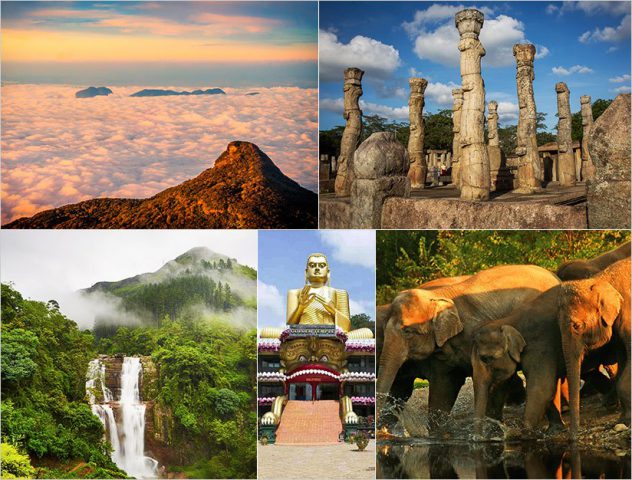
Sri Lanka is one of the most popular tourist destinations in the region, as it contains mixture of golden beaches, rare unique wildlife, breathtaking landscapes and a rich cultural heritage. According to the World Tourism Organization, Sri Lanka has the advantage of having 49 sites classified as unique attractions, 91 as rare attractions, and 7 world heritage sites, and 6 of the 300 ancient monuments in the world.
Galle Fort, Sri Lanka
Galle Fort, Sri Lanka
Beaches
With over 1600 km coastlines, Sri Lanka is known to most tourists for its tropical beach resorts, which offer various attractions all year round. The southwestern coast is best from November to April and the east coast is best from April to September.
Some popular beachspots on the south western coast include:
Ambalangoda, home of devil-dancing and mask-making;
Hikkaduwa, a popular underwater sports site with coral gardens;
Galle, its natural harbour was once a Dutch fort, known for lace-making, ebony-carving, and gem-polishing.
The eastern coastal region offers numerous opportunities for water sports, deep-sea fishing, underwater photography, scuba diving at the shipwrecks and coral reefs off the coast, and whale watching.
Popular tourist towns with sandy beaches in East of Sri Lanka include Trincomalee, Arugam Bay, Batticaloa, Kalkudah and Nilaveli.
National Parks and Wildlife Reserves
Despite its relatively small size, Sri Lanka possesses a high level of bio-diversity due to itswide range of topographic and climatic variations. Sri Lanka is known as one of the 25 bio-diversity hot spots in the world as identified by Conservation International.
The country has abundant bird life with 251 species resident and 21 out of the indigenous to the island (Mathews, 2000). Since the late 1930s, various areas totalling approximately 4660 km2 have been designated as National Parks (7% of the island) and an additional 3270 km2 assanctuaries, reserves, and protected areas (5% of the island).
Many of the National Parks andwildlife reserves are now popular tourist attractions.
The Yala (Ruhuna) National Park, located in the southeastern corner of the island, and the Gal Oya National Park are popular forviewing large wild elephants and undertaking organized safaris.
Wilpattu National Park is among the oldest and the largest National Parks in Sri Lanka. Key tourist attractions of this National Park is its large network of Villus (Natural Water Tanks) and it is famous for visiting Leopards and wild bears.
The Uda Walawe National Park, located in southeast of Colombo, supports large herds of wild animals such as spotted deer, sambhur (a member of the cat family), and wild boar.
The Horton Plains National Park, located in the hill country, is Sri Lanka’s highest and most isolated plateau and serves as the habitat for the endemic purple monkey and sambhur. The Horton Plains National Park is famous for the precipice known as the “World’s End” — a cliff with a sheer drop of 1050 m.
The Bundala National Park provides habitats for all species of waterbirds resident in the country as well as the annual influx of migrant birds from August to April.
To preserve displaced young elephants, an elephant orphanage has been set up by the Department of National Zoological Gardens at Pinnawela, 13 km from the main Colombo-Kandy road at Kegalle Town. With over 60 elephants in captivity, the Pinnawala Elephant Orphanage is reported to be the largest captive herd in the world.
Pinnawala Elephant Sanctuary
Pinnawala Elephant Orphanage
Cultural Triangle (Heritage Tourism)
Sri Lanka has inherited numerous magnificent, century-old monuments and cultural relics in anumber of ancient cities. Kandy, Anuradhapura and Polonnaruwa are known as the points ofthe “Cultural Triangle” of Sri Lanka, where five of Sri Lanka’s seven world heritage sites are located.
Within the triangle, Sigiriya is known as the cultural tourism base in this area. Themost important archaeological and cultural site in Sigiriya is the spectacular rock fortress builtin the 5th century AD by King Kasyappa to fend off a feared invasion. Situated atop a 200 m high rock, the fortress houses famous frescoes (rock paintings) on its gallery wall, which is considered one of the finest ancient art examples in the world.
Sigiriya Rock
Sigiriya Rock – Sigiriya is an ancient rock fortress and palace ruin situated in the central Matale District of Sri Lanka, surrounded by the remains of an extensive network of gardens, reservoirs, and other structures. 300+ Meters above sea level, 1200 steps to the top! cc flickr image by Santhosh Janardhanan
Other highlights of cultural tours in this area include the Buddhist cave temples dating to the 1st century AD and agigantic recumbent image of the Buddha carved out of rock in the town of Dambulla; the largest manmade reservoirs, “Parakrama Samudra”, and the colossal Buddha images carvedon a granite boulder in the medieval capital of Polonnaurwa; the sacred Bo Tree in Anuradhapura, and an elephant reserve in Habarana.
UNESCO World Heritage Sites in Sri Lanka
Sri Lanka has enormous amount of culture and heritage-based resources. Sri Lanka is home to eight UNESCO World Heritage Sites.
1. Sacred City of Anuradhapura (5 BC)
2. Cave Temples of Dambulla (1 BC)
3. Sigiriya Rock Fortress (5 AD)
4. Ancient City of Polonnaruwa (10 AD)
5. Royal city of Kandy (17 AD)
6. Dutch Fortifications at Galle (17 AD)
7. Sinharaja Forest Reserve
Hill Country
Kandy is known as Sri Lanka’s hill capital. The focal point of the town is the golden roofed Dalada Maligawa (Temple of the Tooth Relic), a temple that houses Sri Lanka’s mostimportant religious relic- the Sacred Tooth of Lord Buddha. The Esala Perahera celebrationsare an annual highlight when a replica of the shrine is carried in a procession accompanied bydancers, drummers, and over 100 splendidly clothed and decorated elephants.
Another popular tourist destination in the hill country is Nuwara Eliya, a small town set in theheart of the tea country. Nuwara Eliya meaning city of lights is also known as ‘Little England’.British who frequented this hill station fashioned it like a typical English village. The city isfamous for beautiful parks, well-kept lawns with hedges, Queen Anne- and Georgian-stylehomes, an Anglican Church, and a golf course. Climatic conditions in Nuwara-Eliya probablydo not match with topical destination characteristics since, it is known as the coldest city of Sri Lanka.
St Clairs Waterfall close to Nuwara Eliya
St Clairs Waterfall close to Nuwara Eliya
Events
The Kandy Esala Perahara, Navam Perahara, Kelaniya Duruthu Perahara, Sinhala New Year, Vesak Poya celebrations, Sripada pilgrimage, Poson festival are some unique cultural and religious events. Additionally there are different events through out the year.
Information source: W.M. Rohan Laksiri (2007) Marketing Sri Lanka: As an International Tourist Destination, Master Thesis, Department of Economics and Business Administration, Faculty of Economics and Social Sciences, Norway